Uncertain times: has it always been this way?

Uncertain times: has it always been this way?

A historian shows how ordinary people across centuries endured upheaval and what that means for us now.

It is a truism in our moment in history that we live in an age of uncertainty. In a world driven by complex and varied interactions, using new technologies, and undergoing rapid economic and social change, we are experiencing new problems on a global scale. It seems like everything is unprecedented, unparalleled or new ground. Every day we are reminded of the terrors of domestic and international strife, war in Europe and the Middle East, turbulent economies, climate emergencies, natural disasters, fraught communities, political polarization, starving communities, those with no home, the rise of artificial intelligence … the list goes on. Every day, we experience, on an individual and collective level, fear and anxiety about our chaotic reality.

But is this feeling unique to us? Humans have, throughout history, confronted the weight of their past and the uncertainty of their present world. But does that history help us now?

Over a decade ago, I moved to Glasgow, Scotland, from my hometown in Belfast, Ireland, to pursue a Ph.D. in history. Like many newcomers to Scotland, I visited Edinburgh during the world-famous Fringe Festival. Since 1947, for three weeks in August, Edinburgh welcomes creative people, projects and art from around the globe, drawing in thousands of performers and crowds from Berlin to Chicago.

Wandering around Edinburgh’s Old Town, I tried to imagine what it would have been like to walk through the city hundreds of years ago. Admittedly, as someone who grew up in a society marred by sectarian conflict and violence, I often find myself looking out for evidence of the cruelties of history when visiting other countries. To a present-day tourist, historical Edinburgh would have been both familiar and unfamiliar. By 1560, the onset of the Scottish Reformation, when Scotland officially became a Protestant nation, the city was populated by around 12,000 inhabitants (a mere fraction of today’s population of more than half a million). Yet, the significant landmarks that draw visitors to the city to this very day — Edinburgh Castle, St Giles’ Cathedral, the Royal Mile — already dominated the city’s landscape by the 1300s.

There are, however, few tangible reminders of the various tragedies that beset the inhabitants of Edinburgh throughout history. The city has faced sieges, plagues, wars, riots, mighty fires and building collapses. During the high point of witch hunting in the early modern period, an outsized percentage of accused witches came from this region. The plague of 1645 was one of Edinburgh’s most devastating epidemics, killing half of the population. A city scarred by tragedy, yet revered for its heritage and beauty.

This history is, of course, not unique to Edinburgh — it’s present, yet often invisible, in every town, city and country on the planet. No matter where I am in the world, I often find myself wondering about how the inhabitants of bygone eras acted and reacted in the face of terrible changes and disasters, and how they coped with the uncertainties of life.

Looking backward

A history professor once told me that “we cannot ever seek to understand our present, let alone imagine a different future, without looking to our past.” It was then I learned that the study of history isn’t just collective — it’s personal. It requires us to look for answers to many of our existential fears, including our place within society, our hopes and dreams for the future, and how we can cope with the harshness of the world during the times in which we live.

History is a driving motivation to understand the facts and fictions of the world. It is a tool to comprehend the purpose of human existence and behaviour. As historians, we often seek to provide answers to questions that remain inherently difficult, if not impossible, to answer.

In his book “The Terror of History,” historian Teofilo F. Ruiz reflected on Western humanity’s efforts to escape from history and its terrors — from natural disasters to the endless succession of wars and other human-made catastrophes. Ruiz described such acts as the “terrors of history” that uncomfortably sit alongside our own societies. Yet rather than focus on the historical event, Ruiz sought to shine a light on those people who were tested greatly, yet managed to continue with their lives. Here, we find small sacrifices and acts of courage in the face of uncertainty.

In June 1652, Jonet Wood, an ordinary woman from Glasgow, watched as what would become known as “the Great Fire of Glasgow” ripped through the houses of her friends and neighbors, the shops she patronized. The flames devoured the community, destroying about a third of the city. And there was no one but the people of Glasgow itself who could save them. Residents formed human chains, passing buckets of water between them in attempts to put down the flames.

But Wood went further. She ran back into buildings that were engulfed in flames, attempting to rescue those trapped inside. In the face of a literal wall of fire, she moved forward, endeavoring to save anyone she could. From a journal entry preserved from this time, we discover that the town council paid a local surgeon to cure Wood’s burns and nurse her back to health — a powerful measure of human resilience and kindness in the face of devastation.

When I look to history, I am most interested in these types of stories — the ones that have become easy to neglect. The stories of people who carried on with the grim and sometimes mundane details of everyday life. The people who endured while facing the unpredictability and chaos of life. The people who risked their own lives to save others.

It’s easy to learn about what happened in the past by definition of historic events, but it’s easier to forget the people who existed and persevered in the days and moments before and after the entries of textbooks. We forget to remember the nameless who kept going while facing tragedy, and those who refused to give in despite the hardship surrounding them. Every person alive today is the result of thousands of people who, against all odds, survived past tragedies. As humans, we have the capacity to be resilient, to come up with ideas, to transform who we are — especially in the face of uncertainty.

Threads Through Time

Our ideas about who we are and our place within an uncertain world often feel unique, but they’re tethered to the past. Literally and figuratively. Our ancestors faced angst and anxieties provoked by events and existential questions that feel eerily modern. Even prescient.

It is rare for historians to have access to eyewitness accounts of tragic events from nearly 2,000 years ago, and to learn how ordinary people reacted in the face of calamity. But in A.D. 79, the eruption of Mount Vesuvius, which buried the Roman cities of Pompeii and Herculaneum under ash and volcanic mud, was documented in two letters from Pliny the Younger, who witnessed the catastrophic eruption from a distance. In his letters, Pliny gives a detailed account of the eruption, describing how he refused to leave his mother behind despite her urging him to run and take shelter from the looming ash. He recounts the tragic death of his beloved uncle, the Roman author, naturalist and scientist Pliny the Elder, who perished in Stabiae while attempting the rescue of a friend and his family by ship. In his second letter to Roman historian and politician Tacitus, Pliny recalls a scene of utter disorder: “You could hear women lamenting, children crying, men shouting. Some were calling for parents, others for children or spouses; they could only recognize them by their voices.”

Vesuvius has erupted many times over the years, including in 1631 when a major eruption killed more than 3,000 people and rained ash as far as Istanbul. Researchers believe that Vesuvius will erupt again — but not for a few hundred years. And so the cycle continues.

If nothing we are facing together as humanity right now is novel in our history, then why does it feel as if we are unique in our struggles? Has the world really become more uncertain? Things might feel more uncertain today as negative events tend to be etched into our minds deeper than positive ones.

According to economist Ian Stewart, perceptions that we live in increasingly volatile times arise partly because we are comparing the period since the global financial crisis of 2008 to the period that preceded it. That era, from the mid-1980s to 2007, was one of sustained growth and macroeconomic stability in much of the industrialized world. There is some cultural nostalgia for the 1990s and early 2000s, which can be viewed as a form of escapism from the current unsettled world. For many of us, the familiarity of a time before the internet and social media became pervasive and technology felt like a runaway train is comforting in an increasingly digital world.

But even preceding the internet and social media, there was an unsettling relationship with information, and the power it has to shape history. Prior to the internet, the biggest invention to impact the dissemination of information in the Western world and lead to moral panic was the printing press. The Western printing press is credited to Johannes Gutenberg in Germany around 1440, and it quickly transformed society by standardizing language, spreading ideas and increasing literacy.

Print was revolutionary — it introduced a new world of debate and discussion by creating the possibility of the circulation of ideas beyond borders. For all intents and purposes, it was the internet before the internet. Therefore, it also terrified people, particularly the elites. The fear among elites was that “irreligious” and “rebellious” ideas and thoughts might spread among the poor if there was no control over what was printed and read.

Our modern world is obsessed with the proliferation of false and misleading information online, but early modern people also feared what we would now call “fake news.” Historian Francis Young found that the current news situation has striking parallels with mid-17th-century England. In 1642, strict government regulation and censorship of printing fell to the wayside as the War of the Three Kingdoms intensified. According to researchers at the English historical and cultural journal The Many-Headed Monster, more printed material was published in 1642 than in the entire 165 years preceding the first printing press that began operating in London in 1476.

The absence of editorial control of newsbooks and pamphlets meant that this material resembled today’s user-generated content. According to Young, “all that was required to create news was access to a printing press and the willingness of stationers (the Mark Zuckerbergs of the 17th century) to provide a platform for new printed material.” From a historical perspective, what hits home is not the evolution of these social concerns around the invention of new technology and the spread of new information, but the fact that the whole drama did indeed repeat itself.

As human knowledge expands and technology continues to develop and grow, our ability to forecast the future improves. And yet, as our knowledge of the world deepens and increases, any persisting uncertainties might appear more unsettling — because shouldn’t we know what’s going on if we can know? It’s an interesting thought experiment to consider that the news of a ship lost, completely untraced at sea, is likely to prompt greater unease now than in past centuries.

We may seek to investigate the truth of past events, but in a time of more knowing than ever, we are still somewhat unwilling to accept the reality that much is unknown and that many questions simply defy answers. Despite it all, we must ultimately accept that uncertainty is — whether we like it or not — a permanent feature of human existence. As an emotion, uncertainty can be managed and diminished, but cannot be entirely eliminated.

Fear of tomorrow

Why are we so terrified of the unknown? Why do so many of us live in fear of the future? As humans, we are afraid of change because our brains are hardwired for stability and predictability, a survival trait from our ancestors who were faced with assessing the unknown for potential threats. We collectively fear losing our sense of control in the face of uncertainty. For our entire collective sentient existence, philosophers, writers, thinkers and leaders have sought to provide comfort and meaning amid misfortune.

The philosopher Epictetus, born in modern-day Turkey around 55 A.D., said that “it is not events that disturb people, it is their judgments concerning them.” This idea is one of the founding pillars of the philosophical school known as Stoicism, a school of thought that strived to give people a guide to the good life even when the world around them was troubled.

For Stoics, it isn’t the event or thing itself that causes you turmoil; it’s how you think about it. Stoicism urges us to recognize what we can and can’t control. It tells us to remember that change (and loss) are constant, and that we should not fear something that is beyond our control. And yet, we have and do inherently struggle with this in practice.

It feels like the world has changed a lot since I first wandered the streets of Edinburgh with these questions in my mind over a decade ago. I lost my dad to cancer last year, and that experience tested my outlook on uncertainty and its place in our collective history, as well as my own personal history. I now find myself liberated by the many fears I had of the unknown that consumed me as a young adult, at least in aspects of my personal life. Grief, while intensely painful and unpredictable, is an important practice in what we can control: our reactions and our ability to let go of what’s not important to recenter what is.

I used to worry about what I would now consider trivial things. What sort of job I would end up with after I finished my studies. The news cycle, and being swirled into feeling incredibly anxious about the state of things. I carefully calculated the harms of walking alone on a dimly lit street, making sure I was aware of my surroundings at all times. I didn’t own a car for years as I lacked confidence behind the wheel. In my head, I imagined fake scenarios with those ever-lurking catastrophic outcomes. For a long time, I felt safer in my own company, in my own home, as it was one of the few places where I could control my emotions and my surroundings. Like many people, I can still get caught up on many of these thoughts and feelings, but I can now let go, too. I no longer focus on what is ultimately unknown. Losing my dad has taught me that I can comfortably live with doubt, uncertainty and not knowing. Today I live in the moment, knowing that I am certain of only one thing — it will, at some point, come to an end.

When it comes down to it, we all face uncertainties alone — where we might live, what career we might have, who we might fall in love with, when we might lose a loved one. And, in the big picture, we all face uncertainties together — where the economy is headed, what technology will be developed, when natural disasters might strike, which conflicts might reshape our lives and our nations as we know them. But whether it’s war or a pandemic, our relationships or finances, no matter how challenging our lives might feel, we can still thrive.

The assurance within every uncertainty is that we each face decisions in how to respond, and if we will respond in accordance with our values. When each of our individual responses is added up, history is shaped. How we navigate the world around us, how we show up for others — particularly those in need — creates certainty where it can exist. This includes coming to terms with our responsibility to our collective future history through our own actions right now.

When I started my career as a historian, I sought solid answers to fundamental questions about humanity, such as the origins of ideas, the meaning of life and the nature of progress. Today I feel more comfortable in the knowledge that none of us really knows the vast majority of what happened in the past, or what is going to happen in the future.

Humans are complex and messy, and so is history. While we might not be able to individually resolve geopolitical issues or determine the endpoint of artificial intelligence, we can collectively make a difference in society by living authentically and aligning our decisions and actions with our personal core morals, ethics and beliefs. After spending years in the archives studying the ordinary lives of people from hundreds of years ago, the only thing I can confidently say is that uncertainty is a natural part of human existence. It is not a feeling to be feared or avoided. It is a feeling felt by our ancestors and one that will be felt by future generations for centuries to come. And that’s OK.

So now, when I walk through the streets of Edinburgh, I now imagine all of us as future inhabitants of a bygone era that carried on with their daily lives — with courage and compassion — in the face of uncertainty.

This story was first published in Deseret Magazine in December 2025.

Blended families and childcare in early modern Scotland

The nuclear family – consisting of two parents married to each other with biological children – has been privileged for the past century as the normative ordering of society and the upholder of ‘traditional family values’. Men and women who joined together in marriage to start a family were favored by law and society, while those who remained unmarried or those who raised children outside of wedlock were stigmatized and placed on the margins.

The idealistic construction of the nuclear family – which has been upheld as the cultural ideal throughout much of history – is beginning to be challenged in our modern world. The family is no longer an institution forged exclusively through heterosexual marriage and procreation. The legalization of same-sex marriage and advances in medical science enables LGBTQIA+ couples to marry and start a family if they wish to do so. The growing acceptance of divorce and the de-stigmatization of lone-parenthood allows men and women to raise their children either independently or by co-parenting without conforming to the structure of the ‘nuclear’ family unit.

Yet families in the far distant past were just as complex as they are today. In early modern Scotland, the normative family unit did not always consist of a married couple with biological children. As a natural consequence of war, famine and plague, many men and women experienced the death of a spouse and a subsequent remarriage. Blended families – often termed ‘stepfamilies’ in our modern lexicon – were commonplace in the past. This section will explore blended families in early modern Scotland, focusing on remarriage following the death of a husband and how widows cared for children born from multiple marriages.

Blended families

Early modern Scottish families were permeable groups that were formed and reconstructed through marriage, death and remarriage. The nuclear family – consisting of husband, wife and biological children – was short-lived for many men and women across early modern Europe. It has been estimated that 1 in 3 children lost at least one parent before the age of 21 and that at least half of all young women had lost their fathers by the time they married.

Widows would typically remarry men from a similar social and economic background to assist in raising young children and managing their household economies. A whole range of factors influenced a widow’s ability to remarry, including the presence or absence of children, her age, and her economic and social standing. The timing of when a family was broken by death had a profound affect on the likelihood of remarriage for a widow.

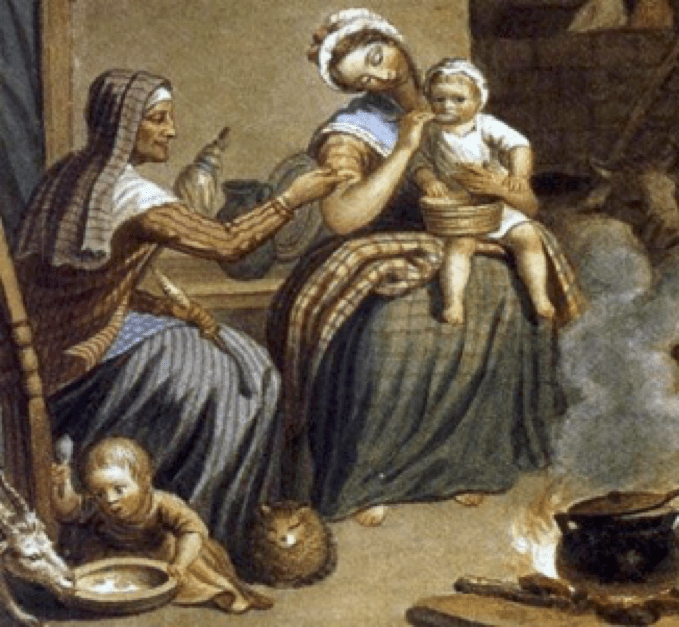
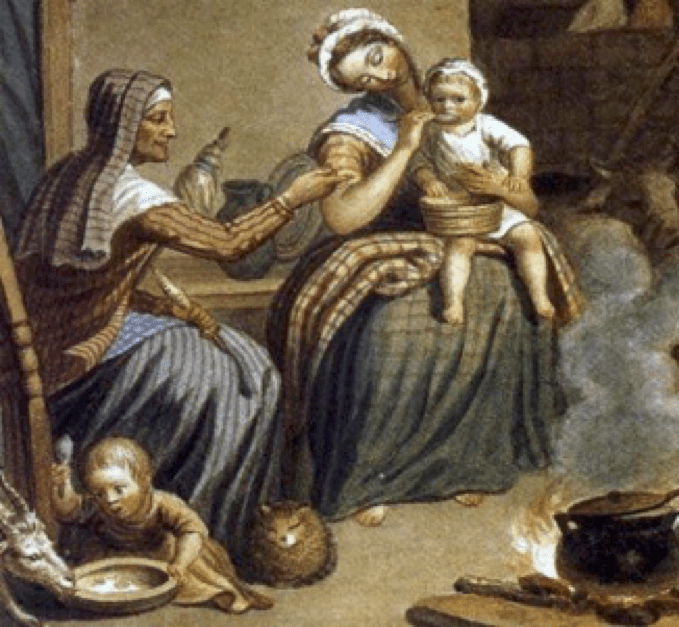
David Allan, (1744-1796), The Scottish Highland Family

A range of legal frameworks shaped the lives of stepfamilies, such as the rules of guardianship on whether children could join their mother when she remarried, and how children and stepchildren might share an inheritance. Legal officials were aware of the complications that could arise following a widow’s remarriage. Mothers were only entitled to act as tutrixes (legal guardians) to their children as long as they remained widowed. The office of tutory granted women control of their children’s inheritance portions while they remained in their minority (the age of 12 for girls, 14 for boys).

Fears that a covetous stepfather could seize control of the children’s inheritance was a constant concern in legal handbooks. At times, husbands sought to regulate their wives’ control of family property in their wills and testaments, with the underlying dread that a new husband – and by extension a stepfather – could potentially squander the children’s inheritance. Prior to his death in November 1609, John Lennox, a burgess of Glasgow, noted that his wife Jonet Graham was entitled to enter as ‘tutrix’ to their three children, including ‘the bairne or bairnes [child or children] the said Jonet is p[rese]ntlie with [i.e. pregnant with]’, noting that the office of tutory was only to ‘indeur during hir weadowhood.’ If Jonet decided to remarry, she would lose control of her children’s inheritance, and the legal guardianship of her children would pass to members of her late husband’s kingroup.

Childcare

When a widowed mother decided to remarry, she was expected to liaise with members of her deceased husband’s kingroup when providing care for any children she brought to her new marriage. Children under the age of seven typically resided with their mother after the death of their father. Older children would live with members of their father’s kingroup or else train in apprenticeships or work in domestic service in another person’s household. The mother’s financial obligation towards her children was subject to much deliberation in Scottish legal handbooks. Sir John Erskine, in his 1773 legal handbook Institutes of the Law of Scotland, argued that mothers should only be liable to provide care provision for the children after paternal ascendants had been obliged to contribute (grandfathers, uncles, and so on) following the death of the father.

Remarried widows approached the law in order to secure regular child maintenance payments from the kingroup of their late husbands. In 1670, Margaret Mathie, a remarried widow, embarked upon a bitter legal battle before Glasgow’s commissary (reformed church) court which involved various members of her late husband’s family.

Margaret alleged that her children’s tutor – her late husband’s brother – was refusing to pay yearly maintenance payments to assist in the care of her three children. Margaret claimed that since her husband’s death in 1666, she and her new husband had cared for the children ‘in household and Familie’ and that they had provided them with ‘meit [meat], drink, bedding and abulziementis [clothing]’. Her new husband also appeared before the court and insisted that he was not obliged to pay for his stepchildren’s care. Remarried widows were clearly expected to negotiate their caring responsibilities alongside their previous husbands’ kin, and new husbands expected to be financially compensated when caring for their step-children.

Conclusion

ew union. Unlike the past, stepfamilies today are usually formed following the breakdown of a previous relationship. In our modern world, childcare is often viewed as a natural consequence of a woman’s role within the family – it is unpaid and undervalued as a legitimate form of work. In the past, however, childcare was compensated and was understood as a necessary form of domestic work for women. The costs of childcare fell squarely at the feet of men, while the physical labour of childcare was overwhelmingly performed by women.

This article was first published on FutureLearn as part of a course on the global history of sex and gender.

Further reading

Stephen Collins, “British Stepfamily Relationships 1500-1800,” Journal of Family History 16, no. 4 (1991): 331–44.

Elizabeth Ewan and Janay Nugent, eds., Finding the Family in Medieval and Early Modern Scotland, (Ashgate, 2008)

Janay Nugent and Elizabeth Ewan, eds., Children and Youth in Premodern Scotland (Boydell and Brewer, 2015).

Lyndan Warner, ed., Stepfamilies in Europe, 1400-1800 (Routledge, 2018)

The Strike that Made Me

The Strike that Made Me

This article was first published in History Workshop Magazine.

Growing up in West Belfast in the 1990s, I was surrounded by the legacy of a particular strike that left an indelible mark on my community: the 1981 hunger strike. The 1981 hunger strike was the result of the British Government’s decision to abolish special category status for paramilitary prisoners in HM Prison Maze. The prisoners’ five demands included the right to wear civilian clothing, the right to organise leisure and education facilities, and full remission of sentences. Following eight long months, the hunger strikes eventually ended in October 1981 after ten men – one of whom was an elected MP – had died.

My mother told me stories of what she called the ‘summer of sadness’ – groups of women smashing bin lids on the footpath to signify the death of another hunger striker became a regular sound and sight for my teenage mother as she walked to and from school. Many people see the 1981 hunger strike as the beginning of Sinn Féin’s long march toward the ballot box that would eventually place its leaders in a power-sharing government under British authority. But for me personally, the 1981 hunger strike represents something different: the importance of standing up for your beliefs and rights, and the power of individuals in enacting wider societal change.

British Army in South Belfast, 1981. Public Domain.

British Army in South Belfast, 1981. Public Domain.

They call my generation “ceasefire babies” – too young to remember most of the terror that occurred but old enough to be affected by the legacy of the Troubles. Like many in the ceasefire baby generation, who are now in their 20s and early 30s, the impact of growing up in a deeply traumatized society continues to shape our experience of adulthood. Walking past the mural of the hunger striker Bobby Sands on my journey to and from school on the Falls Road as a teenager in the 2000s, I was reminded daily of Ireland’s long struggle for freedom, and of the importance of strikes in challenging the status quo.

Young women are fearful about a regression in their human rights

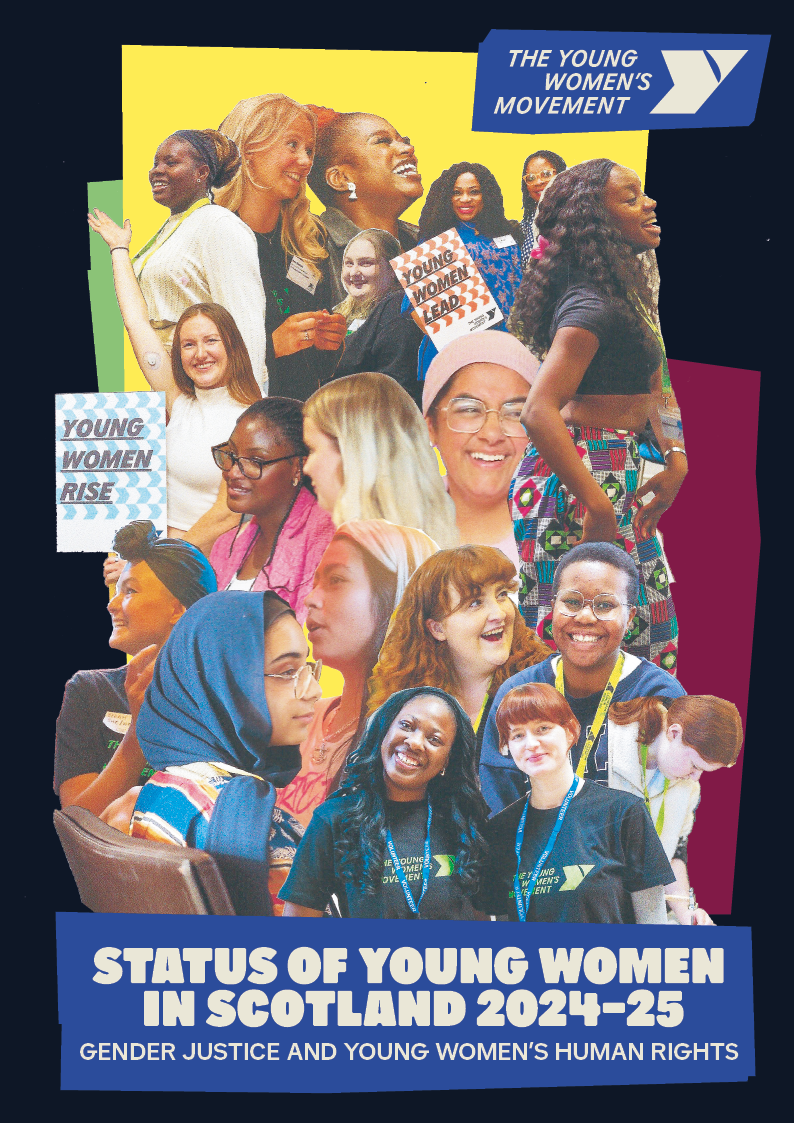
Across the world, young women’s human rights are facing unprecedented growing threats, from higher levels of discrimination to weaker legal protections, and less funding for programmes and organisations that support them.  The Status of Young Women in Scotland 2024-25: Gender Justice and Young Women’s Human Rights report shines a light on young women’s feelings around their human rights and can be done to help them realise the full extent of their human rights in Scotland today.

This research engaged with around 600 young women and girls aged 16-30 from across Scotland, with representation from very Scottish local authority and from all of the target age groups. The report explores a wide range of findings about how young women understand, access and advocate for their human rights in Scotland – from the right to education to the right to live a life free from violence.

Overall, young women across Scotland are very concerned about a regression in their human rights, expressing fear and anxiety as changes in society, culture and politics make their rights feel more precarious than ever. Many young women raised specific concerns about the feminist backlash we are currently experiencing, and the rise of far-right politics at home and globally.

Many young women described frequently not feeling safe in public and online, and the actions they take to protect themselves from the daily threat of violence. The rise of misogyny, particularly online, and the radicalisation of young men in digital spaces, were identified as significant barriers to young women’s human rights.

One young woman said: “Women experience sexual and gender-based violence at catastrophic rates, and it has extremely harmful effects on our physical and mental health and wellbeing, safety in our own homes, ability to access healthcare, and ability to achieve justice.

This year marks thirty years of the Beijing Declaration and Platform for Action where 189 governments from around the world unanimously adopted a ground-breaking agenda for gender equality and the human rights of all women and girls.  

Time alone does not drive progress. As our report shows, young women and girls across Scotland are struggling to have their human rights realised due to poor access to justice, the rise of misogyny, precarious employment opportunities, the prevalence of gender stereotypes in schools and in the workplace, and the persistence of gender-based violence, among many other rights-based issues. We are still waiting for young women and girls’ human rights in Scotland to be fully articulated, protected and fulfilled. 

Against this challenging backdrop, the views of young women in this report give cause for some much-needed optimism. The vast majority of those surveyed identify as feminists, and most believe in the power of collective voice and action to challenge anti-rights actors and increase their confidence and assertiveness in human rights discourse.

The report recommends that changes are needed to improve young women’s practical enjoyment of their human rights in Scotland. So many young women we engaged with had a story about being dismissed, ignored, or exposed to everyday sexism and misogyny that hinders their ability to exercise their human rights. We ask the Scottish Government to commit to introducing the proposed Human Rights Bill to protect young women’s human rights, and reform the criminal law to address rising levels of misogynistic harassment and abuse against young women and girls by introducing the proposed Misogyny Bill, among many other recommendations.

Young women want a better understanding of their own human rights, and how they might access high-quality, evidence-based information when they feel their human rights may have been breached, violated, or ignored. They want to know how to access their human rights in everyday life and safely advocate for their rights in public and online spaces.

Young women need a place to go with their problems, and to know that action can be taken when their human rights are breached or violated. They want to confidently name and claim their human rights and be empowered and encouraged to participate in decision-making and the development of policy and practice that affects them and their rights.   Only by ensuring the human rights of young women and girls – in all their diversity – will we achieve equality, justice and protection for all in Scotland. At The Young Women’s Movement, we promise to work hard to push for a future where all young women and girls, everywhere, realise their human rights and thrive.

This article was originally published by The Herald in May 2025.

Risk and Uncertainty

“The only certainty is that nothing is certain.”

So mused the Roman author and natural philosopher Pliny the Elder (23/24-79 A.D.) in his Naturalis Historia (Natural History). It is unfortunate but perhaps fitting that Pliny would perish in Stabiae while attempting the rescue of a friend and his family by ship from the eruption of Mount Vesuvius, which had already destroyed the city of Pompeii. Two thousand years later, it seems that the passage of time has done little to diminish the power of Pliny’s observation.

We live in an uncertain world. Every day, people take – or, at the very least, consider taking – risks while facing a multitude of unknowns. At this very moment, a mother-of-three is on a hospital waiting list for an operation, wondering if it is worth the risk to take out a loan and instead go private. At the same time, a teenager worries about his future, undecided on whether he should pursue his dream of becoming a professional ballet dancer or instead opt for a career in cyber security. Given the ongoing redundancies in the humanities across the UK, I’m currently weighing up my own career options, wondering if it is worth the risk to remain on the academic job market, possibly waiting years for that elusive permanent position, or else attempt to forge a career outside of academia. Like many in my position, I’m uncertain.

Dealing with risk and uncertainty is a fact of life, despite making many of us feel deeply uncomfortable. Whether struggling to make life-changing decisions, experiencing difficult personal matters, or simply trying to cope with unfolding events or world-wide disasters, people regularly face and experience moments of risk and uncertainty; a reality not limited to a particular time, place or space.

As concepts, risk and uncertainty are traditionally applied to moments of environmental and economic crisis, both real and imagined. Terrorismmass unemploymentinflationpublic health emergencies and environmental catastrophes remain high on the agenda for governments and corporations around the world. Crippling concern about the devastating effects of climate change and our planet’s uncertain future has even recently gained a new name: eco-anxiety.

News anchors and journalists duly warn the public of such risks and uncertainties on a daily basis: ‘stay alert, control the virus and save lives’ is seared into the consciousness of most sentient beings in Britain by this point. Amidst the doom and gloom, it is no wonder that some warnings go viral, with RTE weather reporter Teresa Mannion declaring live on TV during the calamitous Storm Desmond in 2016: “Don’t make unnecessary journeys, don’t take risks on treacherous roads…and don’t swim in the sea!”

In recent years, historians have used the concepts of risk and uncertainty to uncover how natural and man-made hazards have threatened human endeavours and existence in the past. Much of this research focuses on how institutions and societies responded to various life-altering events throughout history – from mapping regional attempts to control the spread of bubonic plague during the fourteenth century to questioning how global responses to nuclear accidents shaped risk management strategies during the twentieth century.

This new series for HWO instead seeks to understand how ordinary people calculated risks and faced uncertainties in everyday life in the early modern world. Stretching from sixteenth-century Britain to eighteenth-century Mexico, its articles use the concepts of risk and uncertainty to show how ordinary people made – and often struggled to make – decisions that changed the entire course of their lives, and in turn, how they understood and viewed their position within their respective worlds. Risk and uncertainty became an increasingly familiar condition to ordinary people during the early modern period. The dissolution of traditional political and religious orders, the rise of new faiths and confessions, and the sudden acquaintance with other cultures through organic and forced means, transformed how ordinary men, women and children thought about and experienced risk and uncertainty in everyday life.

The early modern world also shares some features with our present reality: the displacement of people due to intolerance and persecution, the widespread belief in ‘alternative’ facts and the political use of doubt, and the persistent rollback on gender equality and women’s reproductive rights, foster complex questions regarding the meaning of risk and uncertainty in everyday life in both the early modern past and today. From the young woman risking a romantic relationship while weighing up the dangers of pregnancy and consequences of unwed motherhood, to the enslaved boy escaping captivity in an attempt to achieve a kind of liberty that had been stolen from him as a child, the historical record is full of hidden stories of personal risks and uncertainties that irrevocably shaped the lives of ordinary people.

From a purely academic perspective, risk and uncertainty are separate. The distinction proposed by the economist Frank H. Knight over a century ago has become classic. In the case of risk, the outcome is unknown, but the probability distribution governing that outcome is known. Uncertainty, on the other hand, is characterized by both an unknown outcome and an unknown probability distribution. In other words, risk is something that can be calculated but uncertainty defies calculation. According to sociologist Ulrich Beck, a risk society is a society increasingly preoccupied with the future (and also with safety) which generates the notion of risk. The concept of uncertainty, on the other hand, often refers to what is not known, and (for some) what cannot ever be known or quantified.

But for most people, risk and uncertainty are more or less synonymous: things that are uncertain are risky and vice versa. Whether that involves giving an unfaithful partner a second chance, or investing in cryptocurrencies in pursuit of profit, most of us have calculated risks and faced uncertainties at some point in our lives. They are, however, words that have gained heightened relevance in the past few years. As we slowly emerge from a devastating pandemic that affected people across the globe (though to varying degrees) we are now facing the uncertainties of Brexitwar in Europe and the threat of yet another public health crisis.

Studies also reveal that the uncertainty of the cost-of-living crisis is causing lasting damage to the mental and physical well-being of many people. A recent poll by Aldermore Bank found that a third of British people have not made any plans to mitigate the rise in living costs, while that more than a quarter believe their current financial situation is not sustainable. Many of us currently exist in a state of suspended uncertainty, aware of the risks that lie ahead yet unable to adequately plan for a rainy day. And torrential showers are forecast for the foreseeable future.

But while we are all aware of risks and uncertainties in our own worlds, we still know very little about how ordinary people calculated risks and dealt with uncertainties, on both a personal and shared level, in the past. Understanding how Viking warriors calculated risks when embarking on their first journey across unfamiliar waters in 793, or how seafaring merchants experienced uncertainties when boarding a ship to cross the Atlantic on a well-trodden route in 1793, is difficult to recover. What we do know for certain, however, is that personal experiences of risk and uncertainty shaped – and continue to shape – the lives of ordinary people in profound ways.

More than sixty years ago E. H. Carr wrote that ‘History consists of a corpus of ascertained facts.’ In school, we were taught to learn important dates and memorise the names of ‘important’ (predominately white, male) people. It wasn’t until I studied History at university that an eccentric lecturer told me that ‘nothing in History is certain’, and that ‘as historians it is our duty to question everything, even dates.’ (In a bid to impress I subsequently argued in a class presentation that the Irish abbot Columba travelled to Scotland in 568, not 563, and that this discovery changed the very course of Scottish history – incorrect, but at least I tried.)

While there is, of course, such a thing as ‘historical certainty’, historians are, to borrow the words of Elisabeth Engel, ‘uncertain narrators‘, faced with myriad silences, gaps, and inconsistencies in the historical record. How can historians possibly represent forgotten or overlooked lives? In many respects, the history of uncertainty is the history of the unknown – how ordinary people experienced and perceived uncertainties in their own lives is, of course, difficult to uncover, especially the further you look back in time.

It is much easier, however, to investigate how ordinary people calculated risks in their personal lives. In my own work, I research how ordinary women negotiated their legal status and property relationships in early modern Scotland. The restriction of women’s property rights within marriage meant that many calculated risks and planned ahead for future uncertain scenarios, including their husband’s untimely death. The certainty of mortality and the uncertainty of its timing meant that when a bride was drawing up her marriage contract with a notary, she was already anticipating the death of her future husband and her access to property as a widow. Without the security of a marriage contract, married women risked financial destitution on widowhood. In early modern Scotland, a bride knew that the death of a debt-ridden husband was potentially disastrous, so she mitigated against such a risk by securing ownership of her inheritance and use of her marital property in her marriage contract, before she had even walked down the aisle. During the early modern period, recourse to law for ordinary women was therefore essential in successfully managing perceived and real risks and uncertainties in daily life, and upon life-altering events.

According to Scott Gabriel Knowles, the ‘certainty’ of the historical record is an ‘artefact of a time when women, minority groups, workers, and nonhuman life/the environment were not part of the enquiry.’ Accepting a wide range of historical fields and methodologies – including gender, social, family, labour, queer, race and ethnicity, and many more – challenges the ‘certainty’ of history by adding complex and often marginalised perspectives, collapsing the idea that the course of history follows a definable progressive direction. Just like our modern world, history is complicated – we should embrace the uncertainty, fuzziness and speechlessness of the past in all its splendour.

A varied history of risk and uncertainty can provide alternative stories that foreground the rich diversity of human experience in the past. It also might help us think about our own position in the world today – as people with our own experiences of risk and struggles with uncertainty, though living in a different time and place. From the married woman fleeing her abusive husband in sixteenth-century London, to the enslaved woman petitioning for her freedom in eighteenth-century Mexico, this new series explores how ordinary men, women and children in the past understood and coped with risk and uncertainty during times of personal crisis and in everyday life. In doing so, it seeks to illuminate our own experiences of navigating an increasingly uncertain world.

This article originally appeared on History Workshop Online. To read other articles published in the series, click here.

What’s In A Surname?

What’s In A Surname?

Tweet Share Share

“So are you going to change your name or not?”

If you are a woman who has publicly stated your intention to marry a man in 21st century Britain, you have probably been asked this question (or at the very least a variant of this question) by friends, relatives, or even strangers.

A 2016 survey found that around 90% of women in Britain take their husband’s surname on marriage. But this was not always the case. In the past, surname adoption on marriage was a highly variable and fluid cultural practice rather than a rigid, legally dictated one. In medieval England, many women kept their family names on marriage. In parts of early modern Britain, notably Scotland and Wales, most women kept their family names on marriage, while English women increasingly adopted their husbands’ surnames. Men sometimes even adopted the surnames of their wives, and it wasn’t uncommon for children and grandchildren to assume the surnames of their mothers and grandmothers.

That a woman took her husband’s name on marriage was a practice that I did not begin to question until my late teens. By the time I reached my twenties, I was labelled “a bit of a mad feminist” by a then boyfriend when I suggested that he could rightly take my name on marriage if he so wished. Others have told me to “think of the children”, insisting that it is only right for children to share a surname with their parents. Putting the interests of fictional children aside, it is a debate that has sparked heated discussion and fruitful debate whenever I’ve raised the topic with family, friends and strangers. (On a separate but related note, I’ve been called worse when suggesting that people should sign prenuptial agreements before ever getting married, but that’s a story for another day.)

The idea that a man and woman – and I’m specifically referring to heterosexual couples here for reasons that will become clear – unite as ‘one’ person in marriage through a shared surname can be traced back to legal and cultural practices in early modern England, most notably through the common law doctrine of coverture.

In a system of coverture, the husband and wife became ‘one’ person, with power and authority vested in the husband alone. Through coverture, the wife lost her right to own or use property without her husband’s consent, and any property she owned prior to marriage became under the ownership and control of her husband, with certain limitations on her inherited property. As well as losing her property rights, the entirety of a woman’s rights, obligations, and very existence were subsumed by those of her husband. According to Sara M. Butler, an English wife ultimately became “Mrs Him” under coverture. During the early modern period, female name changing therefore became closely connected to property rights and legal personhood, such that the person with the property and legal authority – usually the husband – was the holder and creator of the shared family surname.

Yet, before the doctrine of coverture became firmly cemented in legal thought, English women did not always take their husbands’ surnames on marriage. Prior to the Norman Conquest of England in 1066, it was quite common for women to keep their family surnames on marriage, and children even sometimes took the surname of their mothers. Surnames such as Margretson (son of Margret) and Madison (son of Maddy, nickname for Maud) are just a few of a great many examples of this type of naming. Medievalists have suggested that following the introduction of new restrictions on the inheritance and property rights of women following the rise of feudalism, it was becoming increasingly common for English women to take their husbands’ surnames on marriage. As English women increasingly lost their property rights on marriage, so too did they lose their family surnames.

As an English common law doctrine, coverture only affected English women and women living in English colonies. As a result, early modern England was the only country in Europe in which married women routinely took their husbands’ surnames. So what of women living elsewhere in Britain? In early modern Scotland, the topic of my own research, women kept their family names on marriage, a practice that remained in Scotland until the early twentieth century. In fact, it was considered unusual for a wife to take her husband’s surname on marriage in early modern Scotland. On certain occasions, Scottish men even adopted the surnames of their wives, especially when entering marriages with heiresses who owned significant amounts of land. Scots law (a legal system distinct from that of English common law) afforded married women with specific property rights that were not afforded to their English counterparts: neither partner to a marriage could dispose of land without the other’s consent and, if a wife predeceased her husband, her customary share of goods reverted to her kin. Scottish women therefore kept their family names upon marriage not as a gesture of independence, but as an indication of their less than complete absorption into the kindred, or ‘surname’, of their husbands.

Today, diverse communities across Britain maintain different cultural expectations with regards to female name changing on marriage. For instance, it is not part of historical Islamic norms or culture for a wife to take on her husband’s surname. Yet, despite these different views and practices, reference to “tradition” remains strongly embedded in British marriage practices and ceremonies. It remains tradition for a man to ask for a father’s permission to marry his daughter. It remains tradition for a father to walk his daughter down the aisle before ‘giving her away’ to her new husband. It remains tradition for three men – the father of the bride, the groom and the best man – to speak at the wedding reception. It is therefore not entirely surprising that it remains tradition for a woman to assume her husband’s surname on marriage.

While feminists and critics of marriage vocally condemn marriage as a patriarchal institution that overwhelmingly benefits men over women, it seems that many heterosexual couples continue to adopt a traditional outlook when planning their weddings and embarking on married life in 21st century Britain. In the 2016 survey, nearly three-quarters of married women aged 18 to 34 had taken their husband’s surname. Any woman in her twenties and thirties with an Instagram account will be familiar with pictures of old school friends wearing white wedding dresses and throwing bouquets of flowers towards the direction of their bridesmaids. The subtle name change usually appears online after the marriage certificate has been registered after the wedding. Given that the UK divorce rate is estimated at 42%, it is somewhat surprising that so many women continue to assume their husband’s name on the assumption of ‘till death do us part’, rather than ‘till divorce do us part’.

In recent years, magazine editorialsnewspaper columns and online forums have discussed the reasons as to why most women in Britain continue to change their surname on marriage. Women themselves have also become increasingly vocal about their decision to change their name on marriage (or not), explaining their personal reasons for doing so, their expectations, and, for some, their regrets. I’ve noticed that female academics regularly ask for advice on social media on whether or not to take their partner’s surname on marriage. Some feminists are against it, arguing that it diminishes women’s academic and professional identities, while others argue that it is entirely up to women if they wish to change their surname on marriage or not. Despite such conversations, it remains the norm for the majority of heterosexual women to assume their husband’s name on marriage today, at least in Britain.

It is a topic that regularly comes up in conversation when I visit family in Ireland. My mother took my father’s surname on marriage in 1987 because she wanted to have the same surname as her future children. My sister, after marrying her long-term male partner in 2019, instead decided to keep her family name. Both decisions were deeply personal and decided on after much reflection. Nonetheless, it was my sister’s decision that raised some eyebrows. When she attempted to register with her new workplace shortly after her marriage, an official asked her why she had recorded her family name in her application, despite indicating that she was a married woman. The official then asked her if she could submit evidence of her subsequent divorce or name change from her husband’s surname back to her family name. For whatever reason, the official did not think that it was possible for my sister to be a married woman who kept her family surname.

While personal preference is, of course, an individual choice, we should remain mindful of the strongly gendered status quo of modern times when accepting certain marriage practices as representing the norm. Even today, it would appear unusual for a woman to ask for a mother’s permission to marry her son, or for a mother to walk her son down the aisle before ‘giving him away’ to his new wife. For many, a man taking his wife’s surname on marriage would be considered altogether radical. While there are no available statistics for the UK, a 2016 study revealed that only 3% of men in the US changed to their wives’ names on marriage.

In early modern Britain, female name changing, as a social and legal practice, was closely connected to property, patriarchy and personhood. The practice of female name changing on marriage did not fully take hold in England until the early modern period, and was primarily practiced in countries that followed English common law and recognised the doctrine of coverture. Female name changing on marriage is therefore a practice that reflects and reinforces a gender hierarchy that only truly began to take hold in parts of Britain over four hundred years ago.

We often assume that women’s rights have developed in a linear fashion, from ‘bad to good’ over time. But principles of coverture appear to have become more restrictive and unyielding over time, rather than less so. Rather than a practice steeped in tradition, female name changing on marriage is a relatively recent phenomenon. Perhaps it is time to look to history for inspiration.

This article was first published on History Workshop Online.

Violence against wives in medieval and early modern Scotland

Whether it happened behind closed doors or openly in public spaces, violence against women in intimate relationships occurred as much in the past as it does today. But modern terms like ‘domestic abuse’ or ‘intimate partner violence’ do not easily translate across history. Five hundred years ago, violence against women in intimate relationships was primarily seen as physical ‘correction’: husbands were entitled to discipline their wives and children, and occasional violence was acceptable and even expected in marriage. One historian, Judith Bennett, even depressingly argues that ‘wife-beating’ was ‘a normal part of marriage’ in medieval England.

In our modern era, our understanding of what constitutes abuse in intimate relationships has significantly broadened, encompassing physical violence, but also coercive control and other forms of non-physical abuse, such as emotional, verbal, financial, sexual and even digital abuse. It is also widely recognised that domestic abuse can affect men as well as women, and can occur in same-sex relationships as well as opposite-sex partnerships.

While social understanding and legal acknowledgement of violence against women in intimate relationships has significantly changed over time, important assumptions about domestic violence were forged centuries ago. A first step in tackling intimate partner violence in the 21st century is to understand where these ideas and attitudes have come from. Violence against married women is the most common type of intimate partner violence that appears in historical records. This article focuses on the long history of violence against wives in medieval (c.400-1500 AD) and early modern (c.1500-1800 AD) Europe, while referring to specific examples of court cases from early modern Scotland.

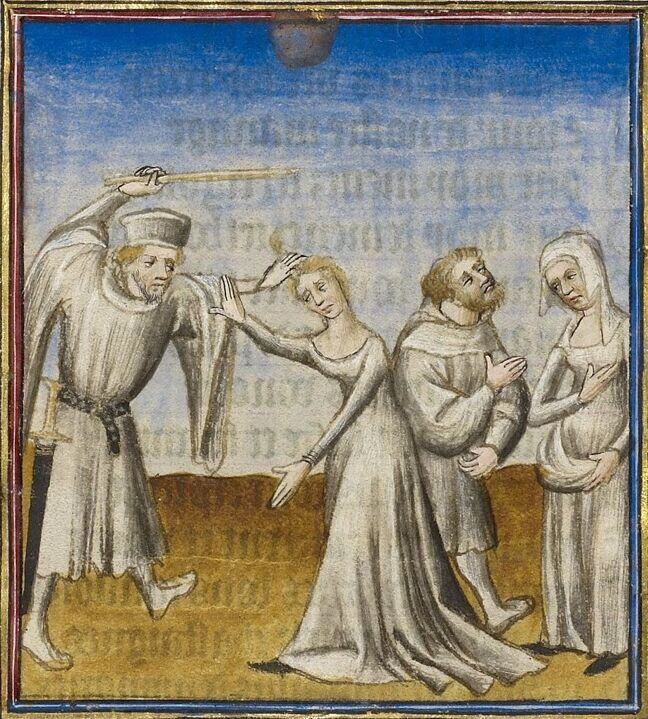
‘Man beating his wife with a stick, c. 1360’. (Source: Public domain via Wikimedia Commons)

In medieval and early modern Europe, a husband had the moral authority to exercise violence to discipline his wife, without resorting to undue force. Catholic and Protestant writers and thinkers discussed models of the ideal ‘godly’ household, with husbands situated at the top of the family hierarchy. The pronouncements on husbandly entitlements cited in Gratian’s 12th-century canon (ecclesiastical) law text Decretum informed generations of opinions:

“A man may chastise his wife and beat her for her own correction; for she is of his household, and therefore the lord may chastise his own… so likewise the husband is bound to chastise his wife in moderation… unless he be a clerk, in which case he may chastise her more severely.”

In other words, violence against wives was considered a necessary consequence of the gender hierarchy in society more generally: husbands were considered ‘kings’ of their households and wives and children were deemed ‘subjects’. A husband was therefore justified in using ‘moderate correction’ to ‘chastise’ his wife but was forbidden from inflicting any serious injury or harm.

By the early modern period, violence against wives was increasingly considered unfavourable and even unacceptable by various moralists and thinkers. The English Puritan William Gouge in his popular household manual Domesticall Duties (1622) argued that it was immoral for a husband to beat his wife. But the majority of Christian thinkers, Catholic and Protestant alike, tended to agree that the authority of the husband required occasional reinforcement with physical punishment, so long as he did not overstep the bounds of modesty and reason.

When violence by a husband against his wife did attract the notice of the courts, responses and penalties varied considerably. Church officials in church courts and magistrates in secular courts tended to agree on one matter: violence against wives had to be justified and motivated by the need to maintain discipline, not the result of uncontrollable anger. Throughout the medieval and early modern period, wife-beating was not considered illegal so long as the husband proved he was punishing his wife for her disobedience or negligence of duty. Secular and ecclesiastical court records across Europe contain thousands of instances of wife-beating. In many cases, the husband was simply reprimanded, fined, or forced to stake pledges from friends and associates to guarantee good behaviour in future.

If a husband exhibited extremely violent behaviours towards his wife, she could appeal to various legal and social measures to try and make him change his behaviours. At other times, a prying neighbour or an eavesdropping servant might intervene to protect a vulnerable wife from her aggressive husband by pushing him away or reporting him to local authorities. In 1651, a Scotsman called William McNair was questioned by church officials for repeatedly beating and ‘striking’ his wife. Neighbours alleged that they heard William regularly assault his wife behind closed doors, with his wife often crying for help late into the night. In response, William argued that he simply ‘corrected’ his wife for ‘not doing what she was told’, which he insisted was ‘lawful’ as her husband. According to William, he was rightfully protecting his household and his reputation.

On certain occasions, wife-beating could be formally charged as an assault, although such prosecutions were rare unless a husband’s violence resulted in his wife’s severe injury or death. A landmark case in medieval Scotland discussed the legal penalties to be imposed on men who were accused of killing their wives. In this case, a husband, who regularly gave his wife a ‘cuff’ to ‘correct her’, was accused of causing her death after she refused food and drink due to his abusive behaviours and subsequently died. In the end, the judges decided that the husband did not cause his wife’s death as he simply ‘chastised her’ as any ‘loving’ and ‘affectionate’ husband would do. If a husband was found guilty of causing his wife’s death, he would face a lengthy prison sentence or, at worst, execution.

A wife sometimes received equal blame for provoking her husband’s violent behaviour. In 1654, a Scotswoman called Jonet McCrae told church officials that her husband regularly beat her when he was drunk, and that:

‘whenever she flees, her husband follows her’.

While Jonet’s husband was criticised for his excessive drinking and violent behaviour, Jonet was urged to return to her marital home and told to ‘amend her faults’ and refrain from angering her husband in future. In 1654, a Scotswoman called Catherine McCray was similarly disciplined by church officials for ‘abusing her husband with her wicked tongue’, despite evidence suggesting that her husband regularly beat her while in a drunken stupor.

Husbands often justified their actions on the grounds that their wives had been unfaithful, or prone to excessive drinking or gambling. If a wife committed – or was perceived to have committed – adultery, or failed to manage her household affairs as her husband’s representative, then the violence employed by a husband was far more likely to be viewed as at least partially excusable in the eyes of the community, and of the law.

This is not to say that husbands were encouraged to physically discipline their wives with impunity, however. In fact, husbands who resorted to excessive violence were regularly reprimanded by neighbours, family members and local authorities. In 1642, a Scotsman called John Matman was banished from his hometown for reportedly placing a scold’s bridle – a metal device used by the church and legal officials to punish ‘gossiping’ women – on his wife’s head ‘out of his own drunken humour’. In 1655, John Ferguson was similarly disciplined by church officials for beating his wife while drunk and attempting to sell her to an English soldier for ‘half a croun’; the equivalent of around £13 today. Husbands who exhibited excessive violence and extreme cruelty towards their wives were seen as dangerous and uncivil, with men only entitled to discipline their wives within the boundaries of patriarchal authority.

‘16th-century scold’s bridle’. (Source: Kelvingrove Art Gallery and Museum, Glasgow, Scotland)

Many aspects of violence against wives seem constant over the centuries. The assumption that the woman was either primarily, or at least partially, responsible for the assault through their behaviour, or as a result of various aspects of their demeanour, persists to this day. In 2021, the World Health Organisation published statistics on violence against women in intimate relationships. Estimates suggest that about one-third (27%) of women aged 15 to 49 who have been in a relationship report that they have been subjected to some form of physical and/or sexual violence by their intimate partner, the majority of whom are male.

Historical cases of violence against wives in medieval and early modern Europe serve as a reminder of the long history of violence against women in intimate relationships. While attitudes have certainly changed – very few people would think it is acceptable for a man to beat his girlfriend or wife ‘within reason’ today – we still have a long way to go to fully eradicate domestic violence and abuse against women in intimate relationships. Challenging outdated, sexist attitudes of gender roles within relationships represents a small step towards building a society where women feel safe and secure, without living in consent fear of reprisal from an abusive partner. Perhaps now is the time to make the 21st century a century for women.

This article first appeared on FutureLearn as part of the course ‘Gender-Based Violence: Responding to Intimate Partner Violence and Abuse’.

Divorce and women’s rights in Scottish history

For centuries, nothing determined a Scottish woman’s identity more than her marital status. For a woman living in Scotland during the sixteenth century, her legal rights were inextricably connected to her relationship to a man: as a daughter to a father, a wife to a husband, or a widow to a former husband. Whether a woman was single, married, or widowed greatly defined her legal, social and economic opportunities during a time when men’s laws ruled women’s lives.    

Prior to key legislative changes in the nineteenth century, Scottish legal rules concerning married women’s rights restricted a wife’s ability to own property, control real estate, enter into agreements, or initiate litigation without her husband’s consent. In other words, a Scottish wife – whether she was living in the thirteenth century or the seventeenth century – could not ever act in law as an independent person. But what of those married women who broke these legal restrictions and fought lawsuits against their own husbands?

While the legalities of separation and divorce continue to evolve today, it is fascinating to uncover how women managed the breakdown of their marriages in Scotland hundreds of years ago, including how separating and divorcing women sought to protect their rights during a time when they were afforded few.  

The history of divorce law – who’s to blame?

The legal history of divorce – and marriage – in Scotland is long and complicated. Following the Reformation of 1560 – when Scotland transformed from a Catholic nation to a Protestant state –  divorce was permitted as marriage was no longer considered a sacrament. After 1560, married persons (regardless of gender) could now divorce their spouses on the grounds of adultery, with a statute of 1573 allowing spouses to seek a divorce on the grounds of desertion after four years. It would not be until 1938 that a Scottish woman could seek a divorce on the grounds of cruelty.

In the early modern period, the law demanded that “blame” be attributed to either the husband or wife when the marriage irrevocably broke down. Whoever was to “blame” for the breakdown of the marriage would subsequently face severe consequences on their property and person.

Scottish divorce decreets made the guilty party legally dead in relation to their spouse. If, for example, a wife committed adultery, she lost her dowry (property or money a bride brought to her husband on their marriage), she no longer had an interest in her husband’s moveable property, and she lost her right to terce – lifelong use of one-third of her husband’s lands – along with any land she held jointly with her husband. She also lost custody of her children.

If a husband committed adultery, the wife maintained a right to all her conventional provisions as if he were dead and she retrieved all the goods gifted to her at and since the marriage. She also retained lifelong rights to her husband’s property, including a share of his moveable estate and use of his land. On rare occasions, she could retain custody of her young children, but only if she could prove that her husband was an unfit parent due to excessive violence, neglect or other behaviours unbecoming of a suitable guardian.

A wife could also seek a judicial separation from her husband. If a judicial separation was granted, the husband was ordered to separate himself from his wife and was subject to sanction if he did not adhere. In a proven case of judicial separation, the court possessed the power to make decisions regarding aliment (care provision) to be paid to the pursuer, and the custody, maintenance and education of children born of the marriage.

A judicial separation ordered one spouse to separate from the other ‘a mensa et thoro’ – this meant the parties remained legally married in law, but no longer had to cohabit as husband and wife. It would not be until the Conjugal Rights (Scotland) Amendment Act of 1861 that a wife could dispose of her property as if unmarried, after successfully being awarded a judicial separation.

Who was to “blame” for the disintegration of the marital relationship therefore mattered a great deal in the past, especially to women.

His property – or hers?

Hundreds of years ago, women typically fought with their husbands over money, sex, excessive drinking and violence before the courts – matters that continue to be debated in solicitors’ offices and courtrooms to this day. The kirk session, a lower-level church court headed by kirk elders, sought to foster harmony between warring husbands and wives before referring difficult suits to the presbytery or, finally, Edinburgh’s commissary court, which held exclusive jurisdiction over matters concerning divorce and separation. In 1560, William Rantoun attempted to initiate divorce proceedings against his wife, Elizabeth Geddes, before St Andrews’ kirk session. In response, Elizabeth countered her husband’s divorce suit, accusing him of the ‘abominable crime’ of adultery.

In her counter claim, Elizabeth alleged that her husband of two years had wrongfully withdrawn his affections and abstracted from her company, leaving her ‘utterly destitute of his solace and entertainment.’ She also claimed that her father had provided William with 200 merks in dowry upon her marriage – the equivalent of roughly £2,500 today – and that in return William had endowed her with joint rights to a house in St Andrews. Elizabeth  further alleged that William had since moved a local woman named Margaret Aidname into the house, and that her husband spent frequent periods of time – sometimes weeks – in her company. In the record, the clerk notes that Elizabeth stated aloud that ‘I aught and should be separated and divorced from him and liberty to be granted to me to marry again’. She also requested the return of her dowry in full.  

Frustratingly, Elizabeth Geddes disappears from the record thereafter. We don’t know if she successfully sued her husband for divorce, acquired a judicial separation instead, or if they subsequently reconciled. We also don’t know if she regained her dowry in full, or if she managed to assert her rights to her house in St Andrews. But what we do know is that many Scottish women like Elizabeth attempted to protect their reputation and rights upon the irrevocable breakdown of their marriage during the early modern period, with some even mustering the courage to challenge their husbands’ authority and rule in public.

The kirk sessions were usually the first point of contact for wives who sought to divorce their husbands. Presbytery courts, on the other hand, regularly heard challenging or puzzling suits referred by the kirk sessions. In 1687, Marie Dhonchie Roy was granted permission by the presbytery of Dingwall to seek a divorce from her cheating husband, Kenneth McCurchie, before Edinburgh’s commissary court. Marie’s case had been referred from Inverness’ kirk session, revealing how women interacted with various judicial authorities when seeking a final break from their spouses.

Yet, despite the introduction of divorce laws in the late-sixteenth century, a relatively small number of women successfully divorced their husbands on the grounds of adultery or desertion in Scotland prior to the nineteenth century. The high cost of litigation meant that it was often only wealthy women who could achieve a divorce before Edinburgh’s commissary court, as has been explored in depth by the historian Leah Leneman. Most women instead sought a judicial separation from their husbands. This meant that the parties were not required to live together and behave like husband and wife; in the eyes of the law, however, they were still technically married and could not remarry another person.

Many ordinary women sought to highlight their husbands’ maltreatment to secure a favourable financial settlement, if not a judicial separation or divorce. In 1589, Elspeth Dundie, the wife of Duncan McGrigor, alleged before Perth’s kirk session that her husband hit her, plundered her house, and had ‘done many other injuries to her.’ Elspeth asked the kirk elders if they could ‘modify her something to live on’, an arrangement that would avoid without the cost and hassle of seeking an expensive judicial separation or divorce before Edinburgh’s commissary court.

Recognition and rights

Divorce law in Scotland has, of course, significantly changed since the sixteenth century. Today, there is only one ground for divorce in Scotland, the irretrievable breakdown of the marriage, which is proven in one of four ways: adultery of the other spouse; “unreasonable behaviour”; one year’s separation if the other spouse consents; or two years’ separation if the other spouse does not consent. Divorce law no longer strips the “guilty” party of their assets, and parties can now apply for legal aid from the Scottish Legal Aid Board if they are unable to fund the costs themselves. Women who find themselves trapped in unhappy or abusive marriages can also seek assistance and advice from feminist organisations, such as the Scottish Women’s Rights Centre or Scottish Women’s Aid.

Prior to the introduction of “no fault” divorce in England and Wales in April 2022, a spouse had to prove that the marriage had irretrievably broken down, which could be shown in one of five ways; the adultery of the other spouse; “unreasonable behaviour”; desertion by the other spouse; two years’ separation if the other spouse consents to the divorce; or five years’ separation in which case no consent is needed. In Scotland, the separation grounds were shortened from two years and five years respectively in 2006.

The introduction of “no fault” divorce in England and Wales on 6 April 2022 is the result of years of campaigning by the legal community. Legal practitioners have argued that the current fault-based system in England and Wales is unnecessarily provocative, in that couples have to appropriate blame for the breakdown of the marriage. 

There has been some pushback, however, from Scottish legal experts to the introduction of a “no fault” divorce system in Scotland, particularly given the gendered implications of the change. Family law specialist Lucia Clark argues that husbands could potentially initiate divorce proceedings without citing any particular reason for the breakdown of the marriage. Given that women continue to face a motherhood penalty, gaps in work, and remain primarily responsible for the care of children following the breakdown of a relationship, the change in divorce law in England and Wales could leave women who perhaps wish to remain married left worse off financially as a result of the divorce.  

Over the past two centuries, Scottish feminists and their supporters have campaigned for women’s right to own property, to seek marital separation and divorce, and to obtain custody of their children before the courts. But women’s struggles for equality in Scotland is not a modern phenomenon.

Hundreds of years ago, women discovered ways to manoeuvre within and around the Scottish legal system in order to gain some form of relief from their marital problems. Just like women today, many were successful in obtaining economic support, if not a final break from their spouses.

This blog first appeared on Engender, Scotland’s leading feminist policy organisation: https://www.engender.org.uk/news/blog/divorce-and-womens-rights-in-scottish-history-1/

Women accessing justice in early modern Scotland

When Jonet Pollock brought suit before Glasgow’s commissary court in 1694, she listed a string of accusations and complaints against her ex-partner, William Jamieson. In her complaint, Jonet insisted that William had refused to pay an outstanding debt due to her, despite the fact she had obtained a favourable ruling from the commissary judge four years previous. Secondly, Jonet argued that William had refused to pay child maintenance following the birth of their son John Jamieson in 1690, alleging that she was owed money for solely providing their son with food, clothing and shelter. Finally, she accused William of breach of promise of marriage, alleging that he had promised to marry her in 1691, and that he had since refused to complete the bond of matrimony with her before church and congregation. As a result, Jonet sought maintenance and damages worth roughly £21 Sterling – a large sum roughly equivalent to £2,500 today – as compensation.

Unsurprisingly, William refuted these claims on both his character and his property. In response to the second charge, William insisted that he had visited Jonet’s household in 1692 and had offered to take their son into his household and bring him up so ‘[he] might be frie of alimenting [maintaining] the bairn [child] in all tyme thereafter.’ And while William accepted that he was indeed John’s father, he argued that he had never agreed to marry Jonet, and that she had instead fabricated the claim following their tryst and subsequent falling out.

This complaint, just one of thousands heard in courtrooms across early modern Scotland, paints quite a picture. On the one hand, it depicts a bitter, personal dispute between two individuals who were engaged in a lengthy legal battle over issues surrounding parental rights and responsibilities, marriage, and debt – matters that continue to be heard in lawcourts to this day. On the other hand, it reveals that women sought legal intervention when they felt wronged, especially when dealing with issues concerning their complex status and rights. In the end, the judge ultimately sided with Jonet, ordering William to pay the outstanding debt and child maintenance until their son had reached the age of fourteen, though the compensation was admittedly reduced. The judge did, however, acquit William from paying damages for breach of promise of marriage, finding no evidence that he had promised to take Jonet as his lawful wife. Even without entirely favourable resolutions, civil legal records tell us much about women’s access to justice and the routes for redress that were available to them during the early modern period.

My research seeks to bring to life the experiences of thousands of ordinary women as they negotiated their legal status and property rights before the burgh (town) and commissary (consistorial) courts of early modern Scotland. During this period, the burgh and commissary courts were key sites for the provision of law and civil justice within urban and rural communities, and therefore regularly dealt with matters that pulled in women and their rights. Despite their inferior legal status and property rights within a patriarchal society, women were found in all forms and manners of civil legal matters and disputes – as pursuers, defenders, witnesses and even legal representatives of their husbands, children and kin relations. Though they did not appear in the same numbers as men, women’s legal action was not exceptional, nor was it prevented.

Some women were involved in a high number of pleas, such as Bessie Lindsen who appeared before the burgh court of St Andrews on nine separate occasions in 1601 when embroiled in a variety of property quarrels involving neighbours and kin relatives. Others were fleetingly involved when their circumstances drastically changed, such as Agnes Crawford who secured a yearly maintenance payment of £31 Sterling  – roughly equivalent to £4,100 today – before Glasgow’s commissary court in 1616 after her husband of thirty-one years abandoned her, apparently without reason. Whether claiming their share of inheritance, protecting their property within marriage, or pursuing their unruly husbands for spousal abandonment, women were pulled into a wide range of legal negotiations and disputes throughout their lifetimes, with their complex rights to property demanding particular attention before the courts.

In the popular imagination, Scottish women are often remembered as victims or rebels of a patriarchal social order. Museums display the tools that were used to silence and punish disobedient women throughout history, while students at schools and universities are taught about the thousands of women who were persecuted during the Scottish witchcraft panics. Today, feminist activists are even campaigning for a national memorial to the thousands of people (mainly women) who were persecuted for the crime of witchcraft in early modern Scotland. But that is only half the story.

While Scottish court books are filled with countless tales of women branded as witches, scolds and sinners, thousands of ordinary women also left their mark, and the purpose of my research is to uncover the everyday (and often relatively mundane) matters that concerned women during this period. Whether appearing through a lawyer, voicing their complaints independently, or avoiding lawsuits entirely, women in early modern Scotland clearly knew their way around the patriarchal legal system; not all fell victim to it.

This blog first appeared on Women’s History Network: https://womenshistorynetwork.org/women-accessing-justice-in-early-modern-scotland-rebecca-mason/